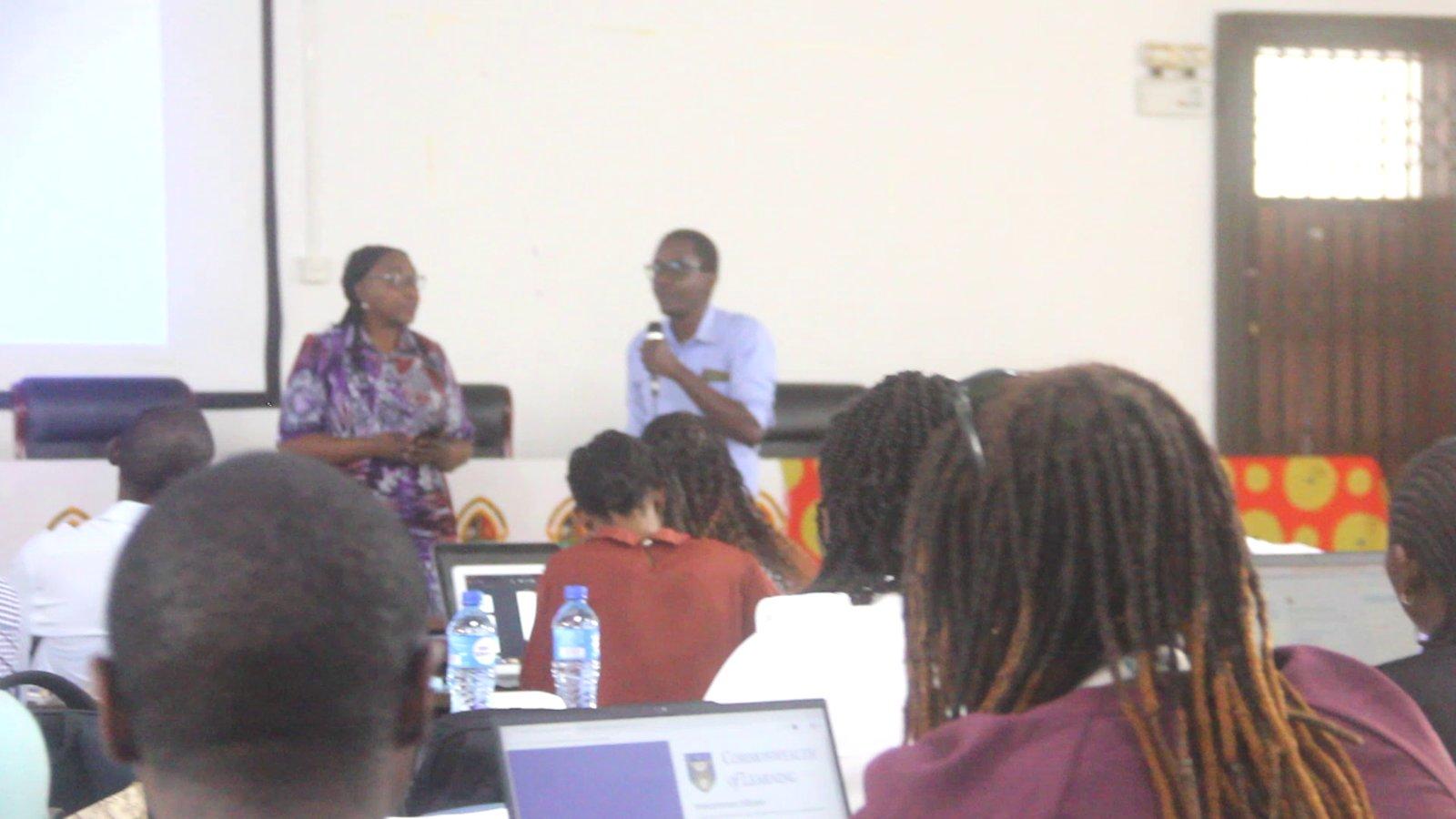
On October 6 and 7, 2026, the Commonwealth of Learning (COL) and the University of Zambia School of Education held a two-day workshop, Harnessing Open Educational Resources for Teaching, Learning and Knowledge Sharing, at the Confucius Institute's Multipurpose Hall at the University of Zambia. Under the theme Creating, Adapting and Sharing Quality Educational Resources for Open Learning, the workshop brought together lecturers and postgraduate students to find, evaluate, adapt, create and openly license Open Educational Resources (OER). Dr Lighton Phiri facilitated three of the workshop's sessions, all built around generative AI and quality.
The workshop was coordinated by Dr Tommie Njobvu of the School of Education, with Dr Betty Ogange, Education Specialist: Teacher Education at COL, who presented COL's collaboration with the School of Education. Other sessions covered the findings of a needs assessment (Mr Evaristo Simweene), the foundations of OER and the 5Rs (Mr Abel M'kulama), finding OER, accessible design, peer review, publishing and action planning (Mr Phyela Mbewe), and Creative Commons licensing and attribution (Ms Chanda Nkholoma-Tembo).
Evaluating the quality of OER
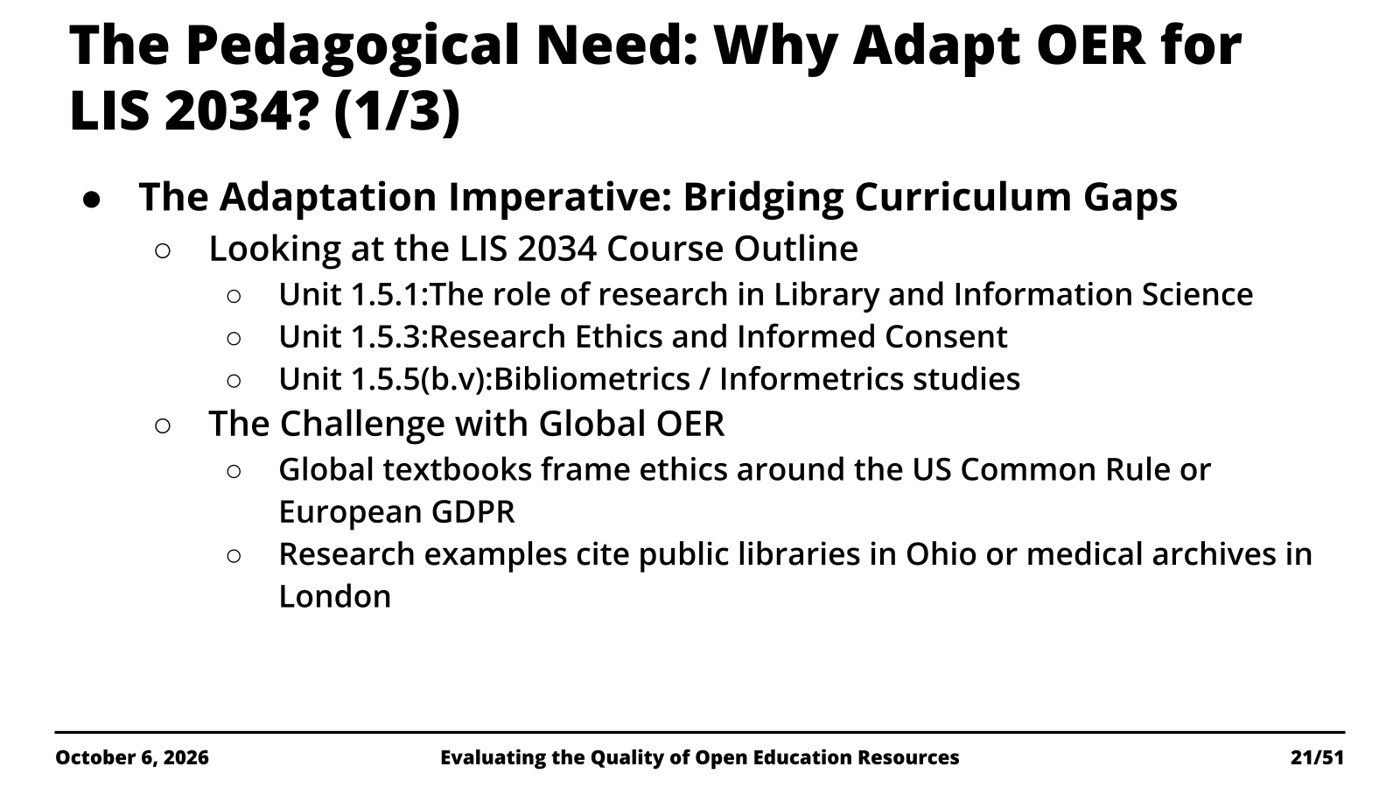
Dr Phiri's first session introduced an evaluator's mindset for OER, using a thought experiment in which a lecturer prepares to teach a research methods course (LIS 2034) from existing open materials rather than writing a module from scratch. Participants worked through a step-by-step evaluation process (content and student fit, legal rights and attribution, and mapping resources against the syllabus to find gaps) and five OER quality pillars, including contextual relevance and inclusivity, before looking at evaluation criteria for different formats. The session also presented DataLab research on a tool that uses data mining to assess OER against the Zambian curriculum.
Adapting and remixing OER with GenAI support
The second session turned evaluation results into an adaptation plan: low scores on context, curriculum coverage or readability became specific revisions or remixes, such as localising research ethics scenarios to Zambian ethics committees. It introduced the generative AI tools available to academics, explained tokens, context windows and retrieval-augmented generation, and taught the CLEAR prompting framework. Participants then adapted resources hands-on using free AI tools, while staying within the terms of each resource's licence.
Creating and evaluating OER with GenAI
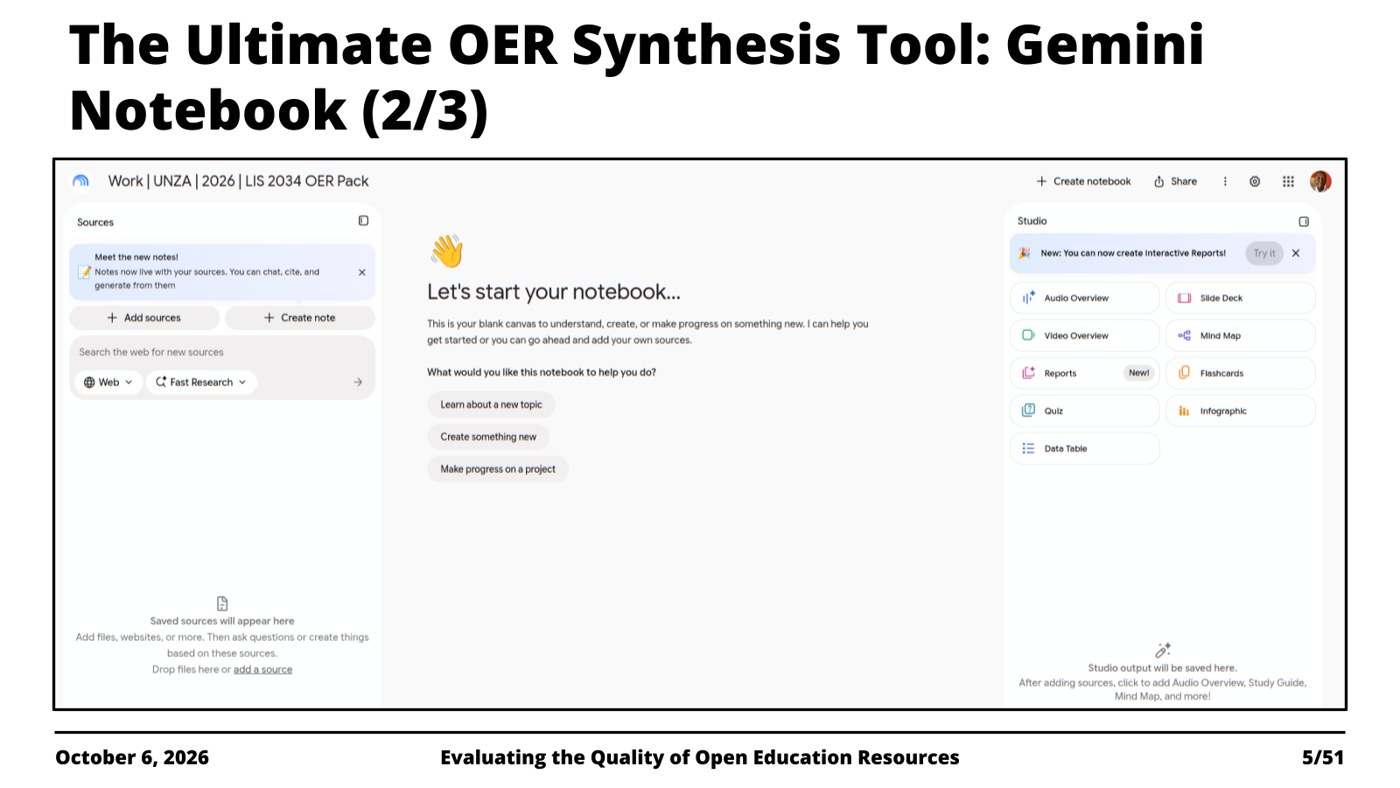
On the second day, Dr Phiri showed participants how to combine several open resources into new ones, using Gemini Notebook (formerly NotebookLM) to generate study guides, FAQs and low-bandwidth audio overviews with citations back to the source material, and standard chatbots to draft assessments and rubrics. The session ended by reversing the lens: using a "five-pillar" prompt to have AI act as a peer reviewer of OER, and keeping a log of how AI was used so that it can be disclosed when the resource is published.